On July 12, 2025, Tether blacklisted 790 addresses on the Tron network in a single day. The total amount frozen? $1.9 million. That’s an average of $2,413 per wallet.
Not $2.4 million. Not $24,000. Twenty-four hundred dollars.
This wasn’t a whale hunt. It was a dragnet — a coordinated sweep of hundreds of low-value wallets, likely mule accounts or distribution nodes tied to a criminal operation. And it was just one day in what turned out to be the most aggressive year of USDT enforcement on record.
By the end of 2025, Tether had frozen 3,509 addresses on Tron, locking up $860.87 million in USDT. That’s a 186% jump in frozen addresses compared to 2024. Combined with Ethereum, the total reached 4,166 addresses and $1.26 billion.
Here’s what the data says about where enforcement is heading — and what it means if you work in compliance.
How USDT Blacklisting Works
Tether’s smart contract includes three privileged functions that only the contract owner can execute. Understanding them is essential context for everything that follows.
Freeze (addBlackList) — The target address gets added to a blacklist. All USDT held by that address becomes immediately immovable. No transfers in, no transfers out. The balance is still visible on-chain, but it’s locked.
Unfreeze (removeBlackList) — The address is removed from the blacklist. This happens when investigation clears the address, or when law enforcement no longer needs the hold.
Destroy (destroyBlackFunds) — The frozen USDT is permanently burned, reducing total supply. Tether then mints an equivalent amount and sends it to law enforcement agencies or to victims. This step typically requires a court order.
Key point: you can’t destroy without first freezing. The gap between freeze and destroy — the legal processing time — turns out to be one of the most revealing data points of 2025.
2025 at a Glance
Here are the headline figures for Tron in 2025:
| Event | Count | Amount |
|---|---|---|
| Freeze | 3,509 | $860.87M |
| Destroy | 455 | $267.66M |
| Unfreeze | 210 | $54.06M |
A few things stand out.
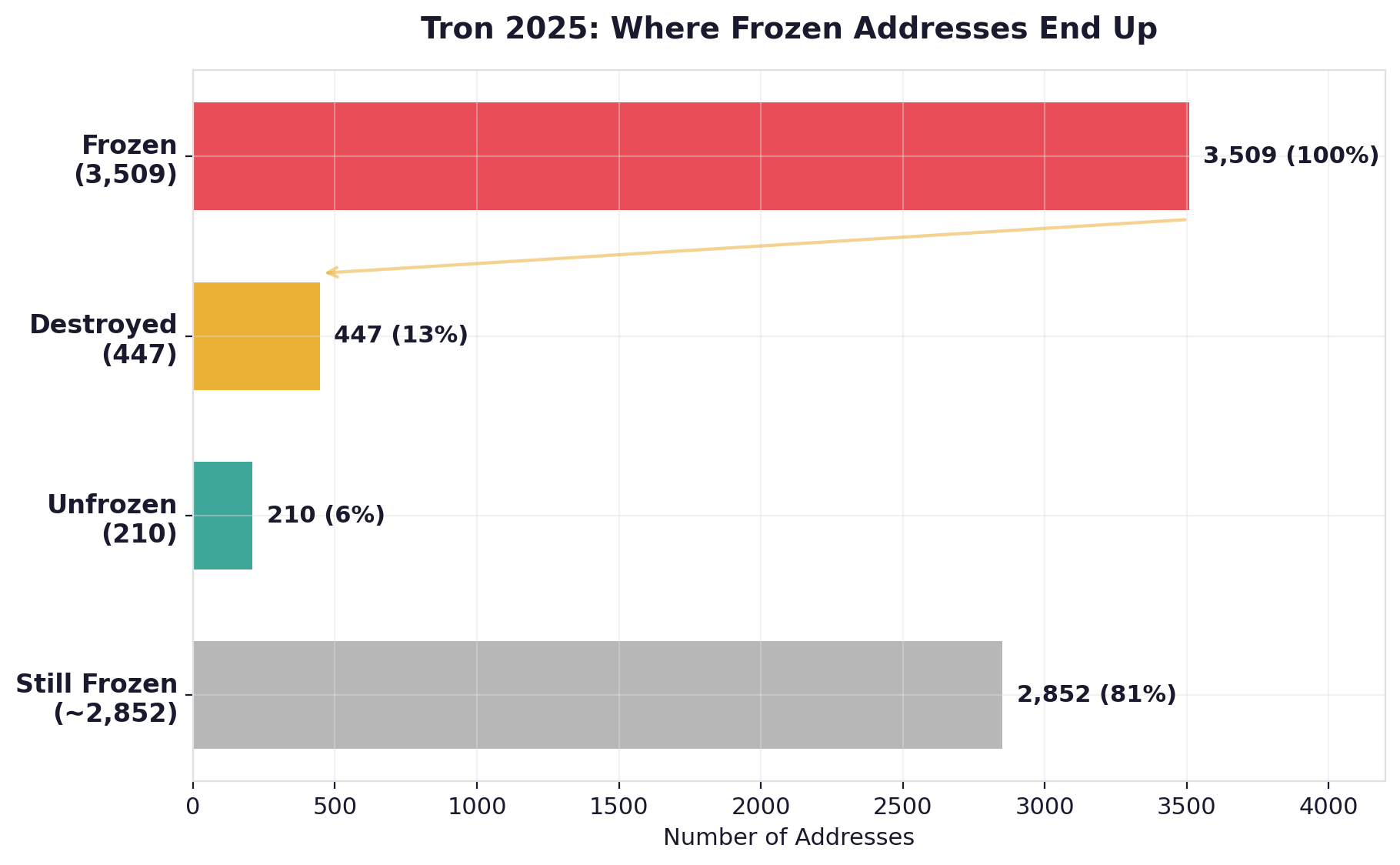
Most frozen addresses remain in limbo. Of the 447 unique addresses that had funds destroyed on Tron in 2025, only 276 were also frozen that same year. The rest had been frozen in earlier years and only reached the destroy stage in 2025. Meanwhile, thousands of addresses frozen in 2025 haven’t reached the destroy step yet. They’re locked, waiting for the legal process to catch up.
Unfreezes are rare. Only 210 addresses were unfrozen on Tron in 2025. Once you’re on Tether’s blacklist, you’re almost certainly staying there. Of those 210, only 2 were later re-frozen. The other 208 remain free.
The monthly pattern is uneven. Freeze activity spiked dramatically in certain months — a sign of coordinated enforcement operations rather than steady-state monitoring.
Monthly Freeze Breakdown (Tron, 2025)
| Month | Addresses Frozen | Amount Frozen |
|---|---|---|
| Jan | 173 | $27.0M |
| Feb | 175 | $49.8M |
| Mar | 224 | $65.6M |
| Apr | 252 | $133.5M |
| May | 342 | $55.8M |
| Jun | 175 | $92.3M |
| Jul | 1,069 | $106.3M |
| Aug | 209 | $79.1M |
| Sep | 316 | $80.2M |
| Oct | 216 | $63.2M |
| Nov | 206 | $55.0M |
| Dec | 152 | $53.0M |
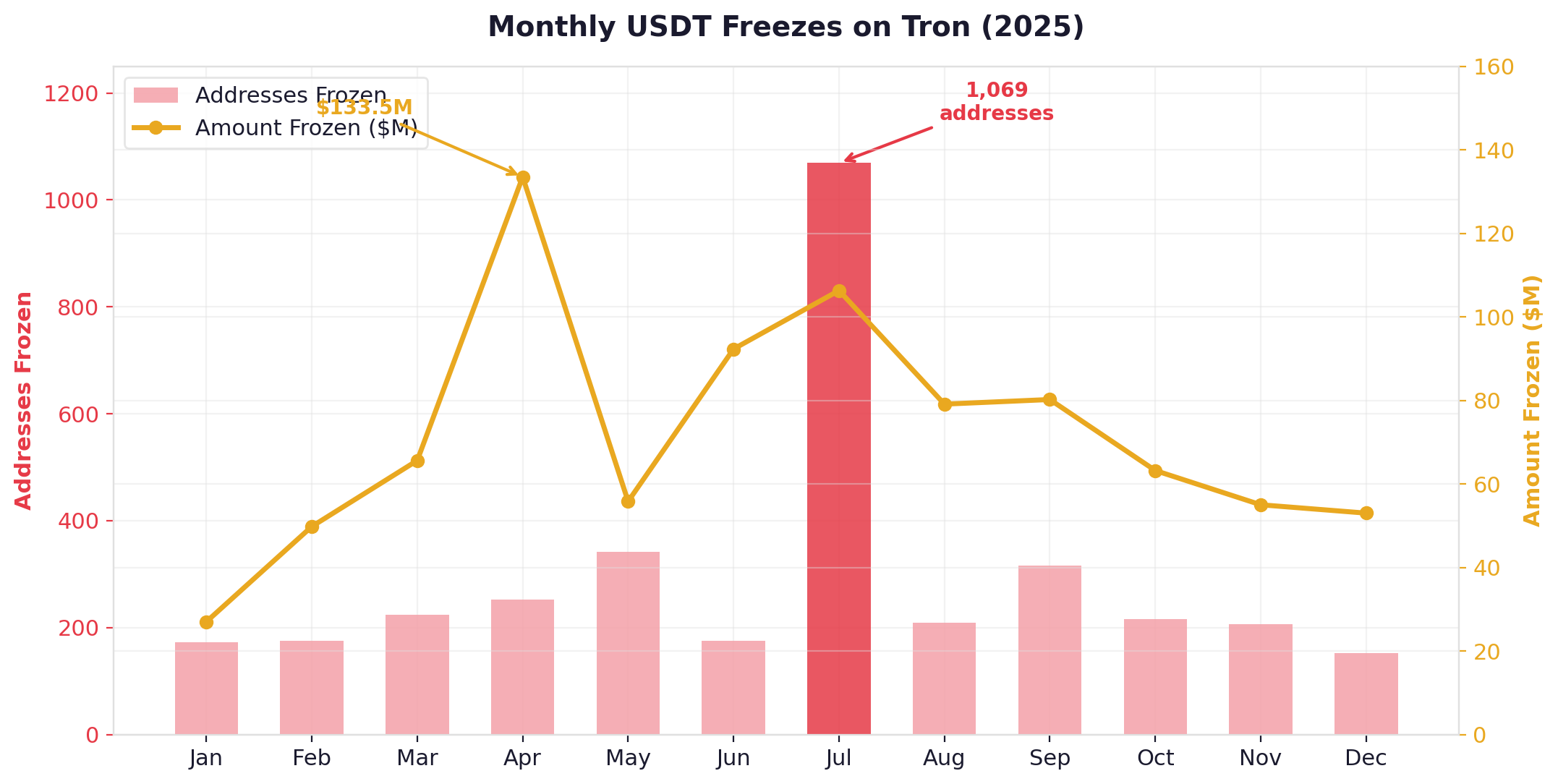
July stands out: 1,069 freezes. More than triple the next-busiest month. The all-time record for Tron freezes in a single month.
But July’s $106.3 million in frozen funds wasn’t the highest monthly total. April froze $133.5 million across just 252 addresses — an average of $530K per address, versus $99K in July.
Something changed between April and July. Not just the volume. The targets.
The Shift: More Addresses, Less Money Per Address
This is the most important pattern in the data.
2024: 1,225 addresses frozen, $898 million locked. Average: $733,000 per address.
2025: 3,509 addresses frozen, $861 million locked. Average: $245,000 per address.
Freeze count nearly tripled. Dollar amount barely moved. Average per address dropped by two-thirds.
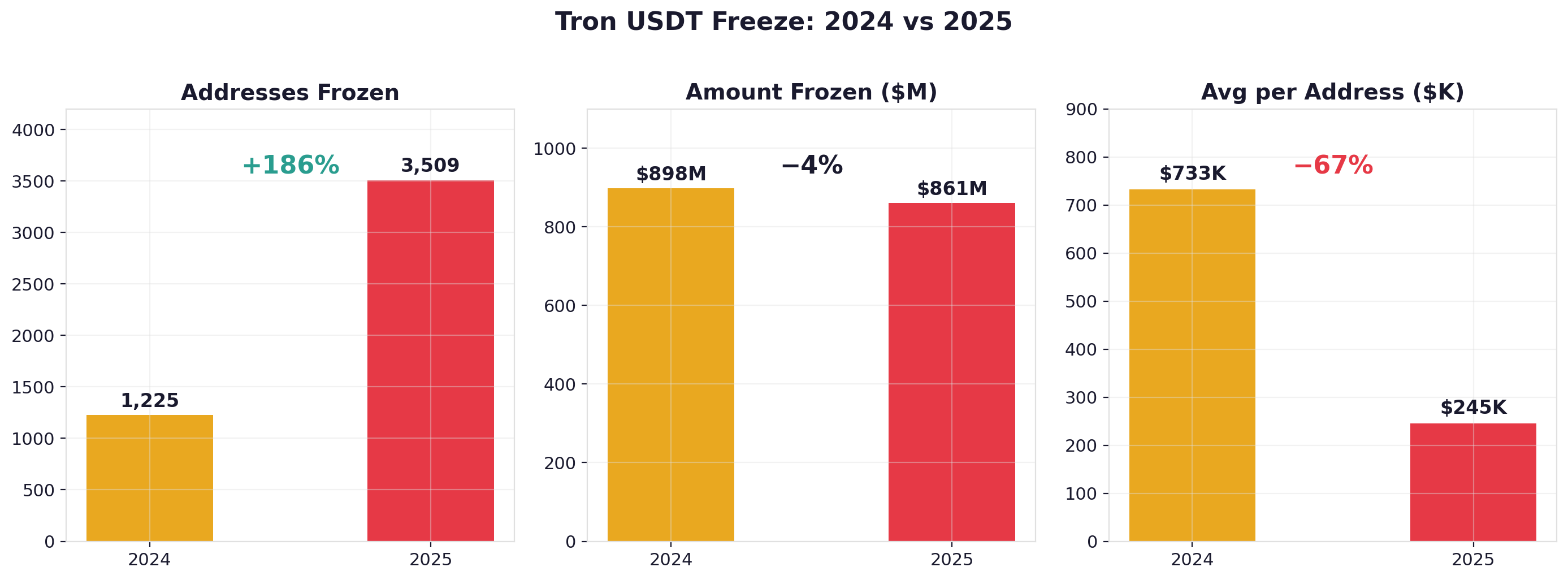
What happened? Enforcement went wide. Instead of chasing a smaller number of high-value wallets, law enforcement targeted entire networks — mule accounts, distribution wallets, intermediate hops.
The July 12 event is the extreme case: 790 addresses averaging $2,413 each. But the shift runs through the full year.
Three forces drove this:
Network-level takedowns. A single criminal operation might use hundreds of wallets to layer and move funds. Freezing them all at once beats playing whack-a-mole one address at a time.
Terrorist financing sweeps. The June-July enforcement wave targeted 151 addresses linked to terrorist organizations, 90% on Tron. These networks use many small wallets to collect and distribute funds. Tether proactively blacklisted 17 Hamas-linked addresses before public seizure orders were even released.
Better tracing tools. Blockchain analytics can now map an entire network from a single seed address. Identify one node, trace all counterparties, freeze them all simultaneously.
For compliance teams: your clients’ exposure isn’t just about direct contact with a big blacklisted wallet. Indirect contact with any node in a flagged network — even one holding a few thousand dollars — can trigger scrutiny. Tools like BlockSec Phalcon Compliance can scan addresses across these networks to assess exposure before it becomes a problem.
Tron vs. Ethereum: Different Chains, Different Crime
The cross-chain comparison reveals two distinct enforcement landscapes.
2025 Freeze Comparison
| Metric | Tron | Ethereum | Tron:ETH |
|---|---|---|---|
| Addresses frozen | 3,509 | 657 | 5.3x |
| Amount frozen | $860.87M | $402.97M | 2.1x |
| Avg per address | $245K | $614K | 0.4x |
| Amount destroyed | $267.66M | $430.76M | 0.6x |
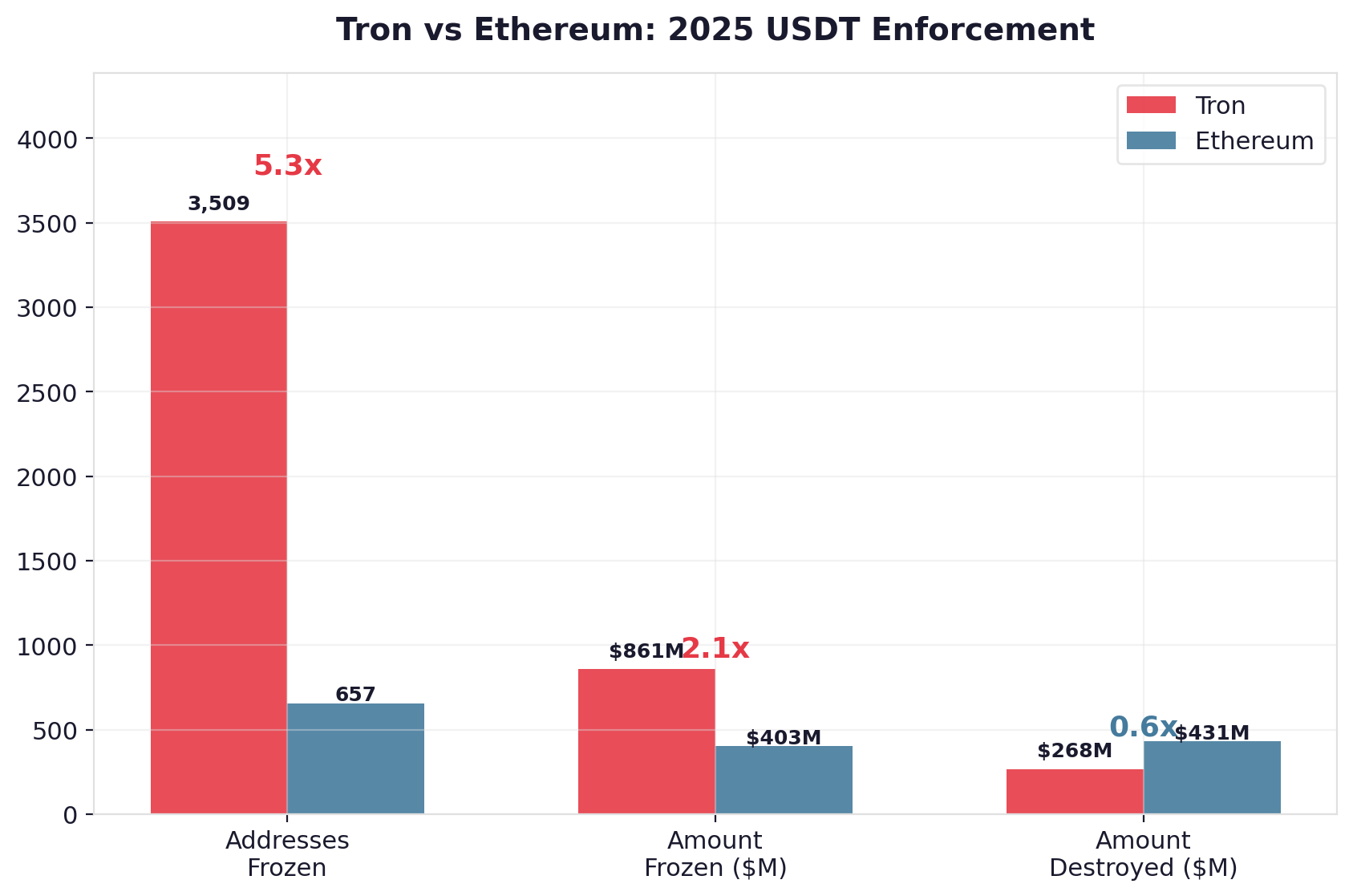
Tron has 5.3x more frozen addresses but only 2.1x the frozen dollar amount. Ethereum’s frozen addresses carry significantly more per wallet — $614K vs. $245K.
The destroy data is even more telling. Ethereum’s destroyed amount ($430.76M) actually exceeds Tron’s ($267.66M) despite fewer events. Ethereum’s enforcement pipeline is more mature: cases reach the court-order stage faster and more completely.
Why Tron Leads in Volume
- Low fees: Tron transactions cost a fraction of Ethereum gas fees — ideal for high-volume, low-value transfers used in scam operations and money laundering layering.
- Fast blocks: ~3-second confirmation times facilitate rapid fund movement.
- P2P dominance: Tron-based USDT dominates peer-to-peer and over-the-counter trading, especially in Southeast Asia, the Middle East, and parts of Africa — regions with high illicit crypto activity.
In short: Tron is where the high-volume, lower-value criminal activity happens. Ethereum is where the bigger individual targets are.
Quarterly Breakdown
| Quarter | Tron Freezes | Tron Amount | ETH Freezes | ETH Amount |
|---|---|---|---|---|
| Q1 | 572 | $142.4M | 172 | $121.0M |
| Q2 | 769 | $281.7M | 112 | $56.3M |
| Q3 | 1,594 | $265.6M | 191 | $118.1M |
| Q4 | 574 | $171.2M | 182 | $107.6M |
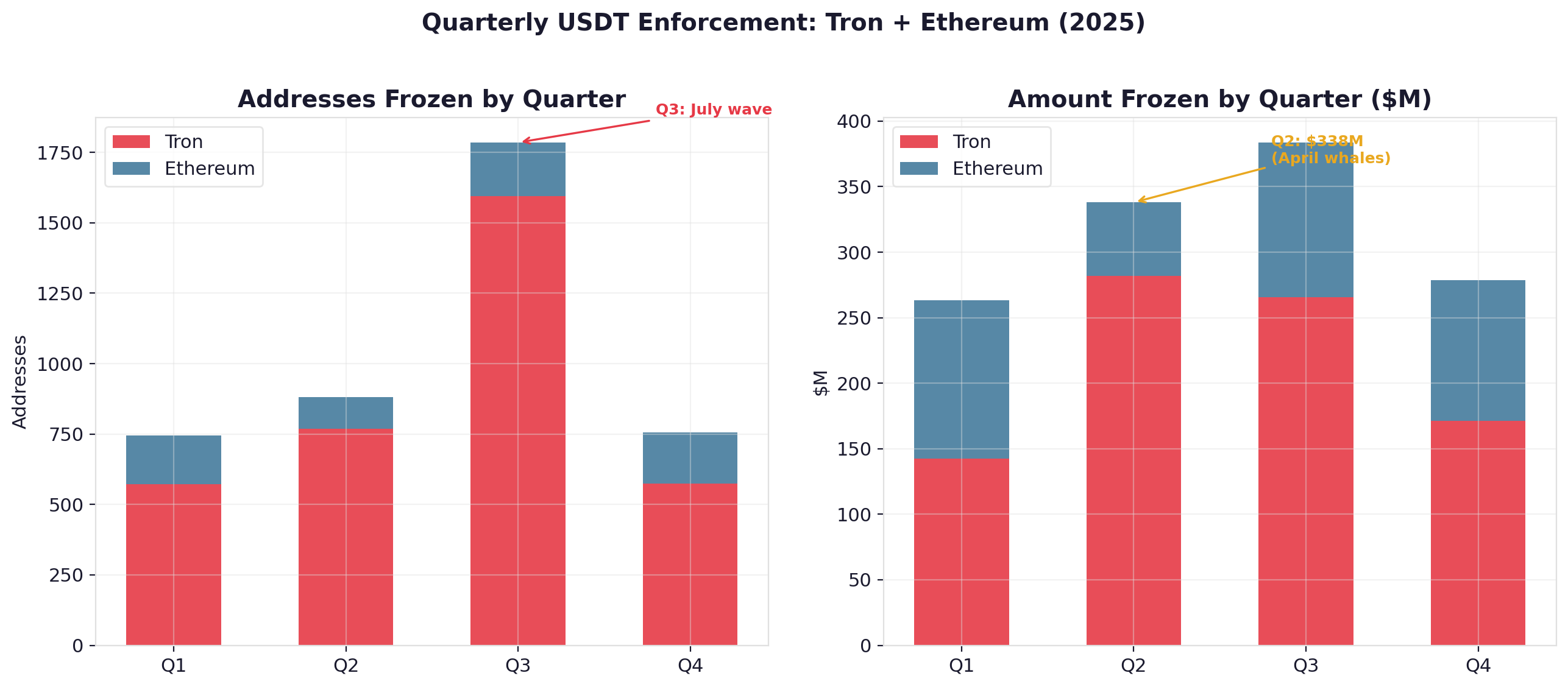
Q3 was peak enforcement on Tron (the July wave). Q2 had the highest dollar amount (April’s big-ticket freezes). Ethereum spread more evenly across the year.
The Cases Behind the Numbers
Data tells you what happened. The cases tell you why.
$225 Million: The Pig Butchering Takedown (June 2025)
The DOJ called it the largest-ever seizure of cryptocurrency linked to “pig butchering” scams. Tether proactively froze roughly $225 million in USDT held in self-custodied wallets connected to a human trafficking organization in Southeast Asia.
The network ran fraudulent investment platforms. At least 400 victims worldwide. Tether and OKX cooperated with the DOJ and FBI. The frozen tokens were burned and reissued to the U.S. government.
What matters for compliance: Tether froze proactively — before formal seizure orders were publicly filed.
$23 Million: Garantex (March 2025)
Tether helped the U.S. Secret Service freeze $23 million linked to Garantex, a sanctioned Russian exchange. The DOJ simultaneously unsealed indictments against two Garantex operators and seized the exchange’s infrastructure.
Garantex had processed an estimated $96 billion in cryptocurrency. An additional $9 million linked to the Bybit hack was frozen in the same operation.
Terrorist Financing: The June-July Wave
Between June and July 2025, a coordinated wave targeted addresses linked to terrorist financing on Tron. In June alone, 151 addresses were blacklisted — 90% on Tron — with $86.34 million frozen.
Tether also froze $1.6 million connected to BuyCash, a Gaza-based financial network. Tether blacklisted 17 Hamas-linked addresses before public seizure orders were released.
The July 12 mass freeze of 790 low-value addresses was likely part of this campaign — sweeping up the collection and distribution layer of these financing networks.
The 164-Day Gap: Freeze to Destroy
How long do frozen funds sit before they’re destroyed?
| Metric | Value |
|---|---|
| Addresses with both freeze and destroy in 2025 | 446 |
| Average freeze-to-destroy time | 228.8 days |
| Median | 164.1 days |
| Minimum | Same day |
| Maximum | 1,726 days (~4.7 years) |
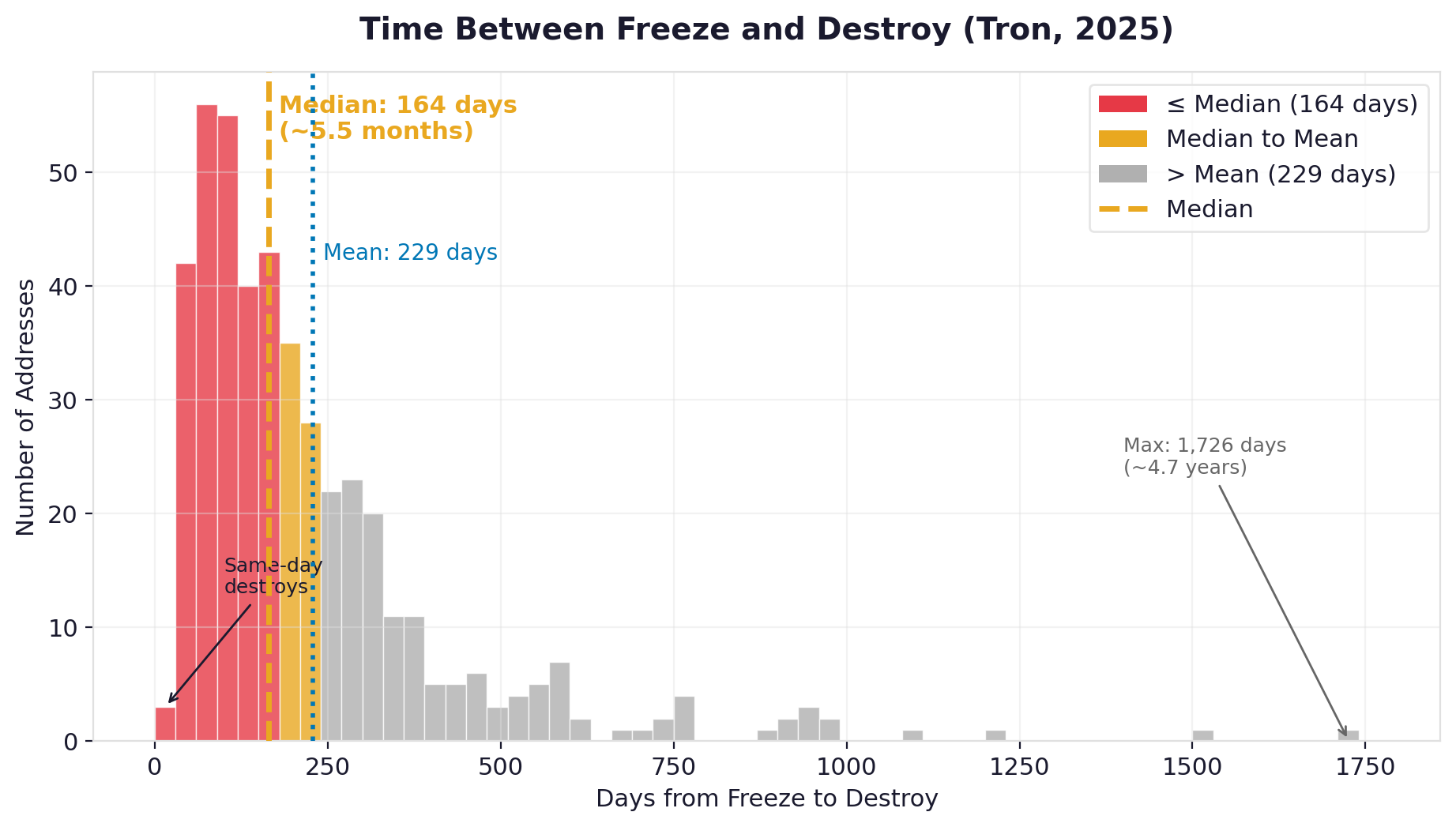
The median is 164 days. About five and a half months. That’s the typical legal processing time — the gap between Tether freezing an address and a court authorizing the permanent seizure.
During that window:
- Law enforcement builds the case — gathering evidence beyond the initial freeze.
- Courts process the request — civil forfeiture complaints, criminal seizure warrants.
- International coordination happens — Tether has worked with 310+ agencies across 62 countries.
- Tether executes the destroy — burns frozen tokens, mints replacements for the designated recipient.
The range tells a story too. Same-day destroys mean the legal groundwork was already done before the freeze. The 4.7-year maximum means some addresses frozen years ago are only now being legally resolved.
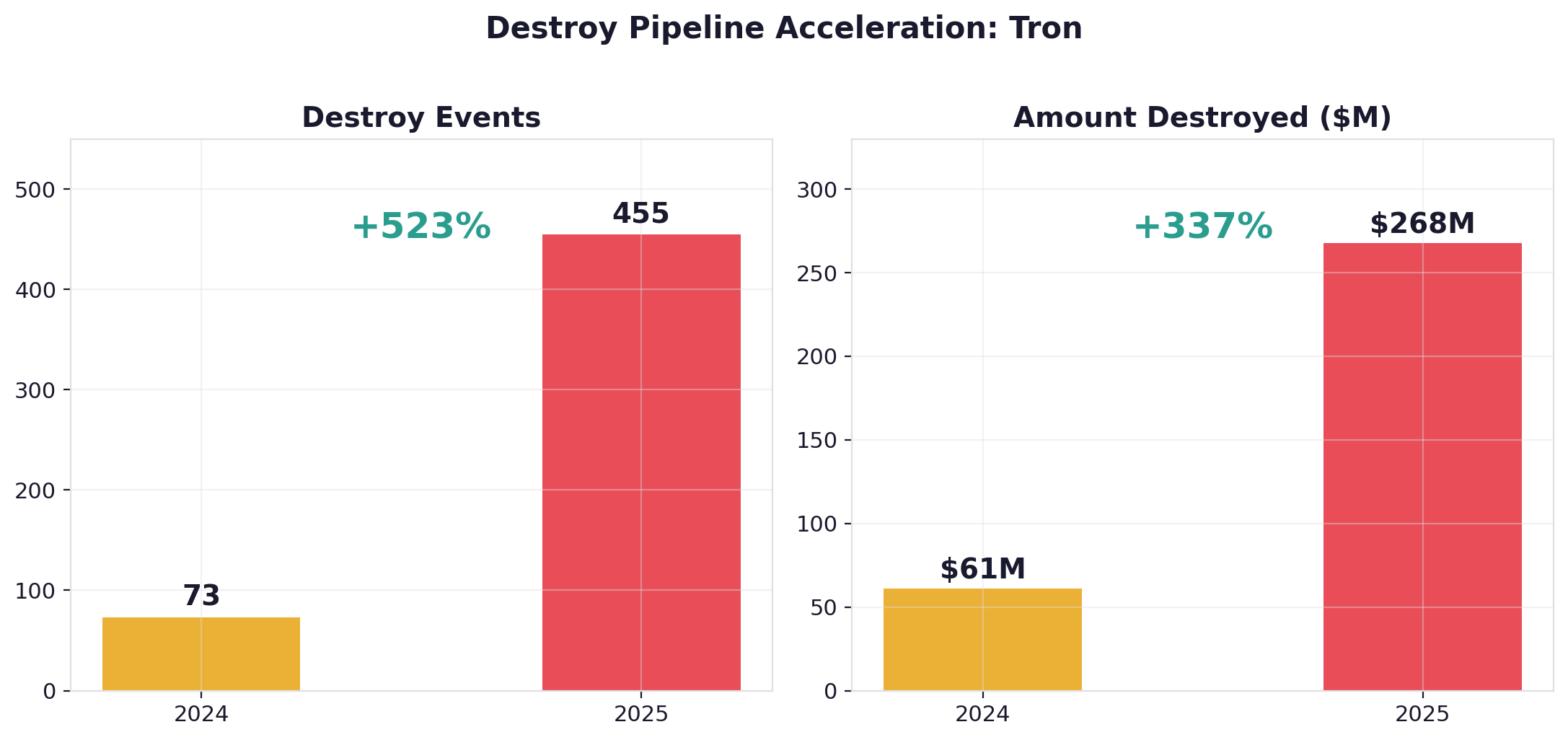
The destroy pipeline itself accelerated in 2025. Tron saw 455 destroy events, up from 73 in 2024 — a 523% increase. Total destroyed: $267.66 million, up from $61.28 million (+337%). Law enforcement isn’t just freezing more. They’re completing the seizure process at a much higher rate.
The monthly pattern shows batch processing. August saw 140 destroys ($49.0M). October: 82 destroys ($73.3M). November: 59 destroys ($46.8M). Large clusters like these suggest coordinated court-order execution rather than one-off cases.
If your client’s address gets frozen, you have roughly 5-6 months before destruction is likely. That’s the window for legal response — filing claims, proving legitimate ownership, cooperating with authorities.
What Compliance Teams Should Do
Six actions the 2025 data demands:
1. Screen Beyond Direct Counterparties
The July 12 mass freeze proves law enforcement now targets whole networks at once. Your monitoring should flag not just direct contact with blacklisted addresses, but second and third-degree connections.
BlockSec’s USDT Freeze Dashboard tracks blacklisting in real time across chains, with detail pages for every frozen address. Pair it with Phalcon Compliance to scan your counterparties’ risk profiles across chains.
2. Take Tron Seriously
5.3x more freeze events than Ethereum. Tron is the primary enforcement front for USDT. If your platform handles TRC-20 USDT — and most do — your monitoring needs to match. EVM-only compliance tools leave a massive gap. Make sure your stack covers both chains.
3. Build a Freeze Response Protocol
Don’t wait for a freeze to figure out your response. Have a playbook ready:
- Notify affected clients immediately
- Preserve all transaction records
- Engage counsel experienced in crypto forfeiture
- Consider proactive outreach to Tether or law enforcement if the freeze looks like an error
The 164-day median gives you a finite window. Use it.
4. Watch for Proactive Freezes
The $225M pig butchering case and the Hamas-related preemptive blacklisting show Tether acts before formal seizure orders go public. Addresses can be frozen on network association alone. Your risk models should account for this.
5. Monitor the Pending Pipeline
At the end of 2025, 37 addBlackList proposals on Tron were submitted but not yet executed. Watching multisig proposal activity gives you a heads-up on coming freezes.
6. Use the New Transparency Tools
In September 2025, Tether announced real-time public disclosure of wallet freezes and blacklist events with timestamps. Build this feed into your monitoring stack.
What Comes Next
2025 wasn’t an outlier. It was a turning point.
- 62.5% of all Tron addresses ever frozen were frozen in 2025. That’s not growth. That’s a phase change.
- 9 of the top 10 busiest months in Tron freeze history are in 2025. Enforcement is operating at a fundamentally different scale.
- Tether now works with 310+ agencies across 62 countries. The cooperation network is global and still expanding.
The question for compliance teams isn’t whether enforcement keeps intensifying. It will. The question is whether your monitoring, your policies, and your response playbooks are designed for the world the 2025 data describes — where 790 wallets get frozen in a single day, where $2,400 accounts are blacklisted alongside $15 million ones, and where the net gets wider every quarter.
The data is on-chain. The patterns are visible. The tools exist. The only question is whether you’re watching.
Data in this article is sourced from BlockSec’s USDT Freeze Dashboard, which tracks real-time USDT blacklisting activity on Ethereum and Tron. Raw data was queried from the underlying database and cross-validated using Python and Go scripts. For real-time compliance monitoring and address risk scanning, see BlockSec Phalcon Compliance.