Agentic payment is having a moment. In crypto you can’t get around x402, the protocol that lets an agent pay on-chain by itself.
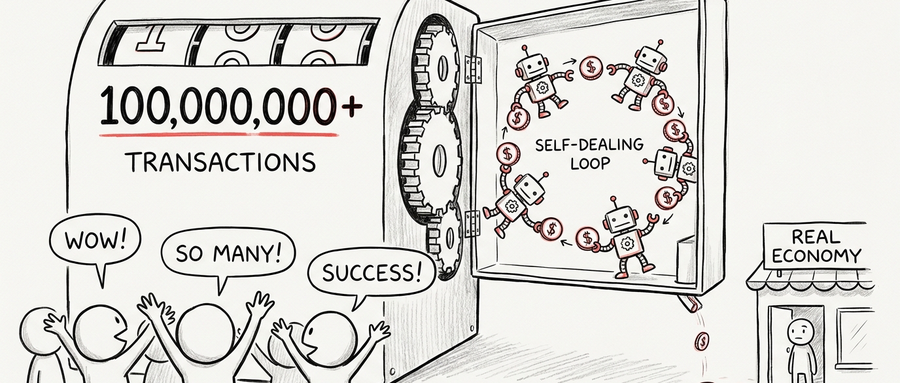
The evidence people reach for to prove agentic payment “is already happening” is almost always the same figure: transaction volume. x402’s cumulative settlement count crossed a hundred million long ago, and that number gets quoted again and again as proof that the era has arrived.
Is it actually happening? To answer that, we teamed up with researchers at City University of Hong Kong and Zhejiang University and ran a full analysis of x402’s on-chain activity. The paper is now on arXiv (2607.12575).
When the analysis was done, I came away with a much deeper doubt about the claim that “agentic payment is already here.” This piece tries to make two things clear. First, where that doubt comes from. Second, a harder question: when every bullish argument for a trend sounds airtight, what do we actually use to tell a real trend apart from a story that is merely self-consistent and may never come true?
How much of “100 million transactions” is real
x402 is a protocol Coinbase launched in May 2025. The trick is to reuse the 402 (Payment Required) status code that had sat unused in HTTP for years, embedding a stablecoin transfer directly into an ordinary HTTP request: every time an agent reads data, calls an API, or fetches a page, it settles a payment on-chain in stablecoins. The protocol spread fast for two reasons. One, it’s trivial to adopt: it runs entirely on existing HTTP standards, so a service can start charging with a few extra lines of code. Two, the cost is minimal: for a sub-cent payment, a card network’s fixed fee alone would cost more than the payment itself, whereas on-chain settlement can handle it.
On Base, we ran a full measurement covering 280 days and identified 136,708,672 x402 settlements, worth $44,121,383 in total (arXiv:2607.12575). At first glance, more than 136 million transactions and $44 million really does look like an economy taking shape.
That’s only the first impression. What we actually wanted to know was: of those hundred-million-plus transactions, how many are real economic activity?
Once we traced where every dollar went, the conclusion nearly reversed. Two things in the data stand out as deeply abnormal.
First, the concentration is extreme. The Gini coefficients for payers, recipients, and amounts are all above 0.98 (where 1 means everything is concentrated in a single party). In other words, the overwhelming majority of “transactions” come from a tiny handful of addresses transferring back and forth among themselves. A real market doesn’t look like this; it should have a large crowd of buyers and sellers who don’t know one another.
Second, the money never actually leaves. We classified each settlement by a very simple test: did this money flow beyond the originator’s own sphere of control? The result: 21.20% is fictitious: the payer and recipient are the same wallet, or the money just circles inside a closed cluster, never leaving, producing no real economic outcome. 63.78% is internal self-transfer within a related cluster: payer and recipient are funded by the same “seed address,” or share a vanity-address format that almost never arises naturally, meaning one operator is paying itself. Together, that’s more than 80% of settlements in which the money never left the originator’s own hands.
So how much genuinely independent economic activity is there? We gave a range. The floor is $188,000, the portion that maps clearly to a specific recipient actually providing a service to others. The ceiling is roughly $20 million, the sum of everything that couldn’t be conclusively labeled as wash traffic. The real independent economy sits somewhere between these two numbers, and they differ by two orders of magnitude. By the most conservative method in our paper, this “economy” of supposedly a hundred-million transactions and forty-odd million dollars has a confirmable real scale of just $188,000.
The recipient side is even more telling: over these 280 days, about 25,000 payable resources were listed on-chain, yet only 249 recipients ever earned more than $10, with a median lifetime income of $3.96. Services that actually make a living on this system barely exist.
In the paper we sum up this manufactured structure in three words: star-shaped, machine-timed, gas-subsidized. Star-shaped means the money isn’t a web woven from buyers and sellers, but a set of stars radiating outward from operators at their centers, almost entirely disconnected from one another.
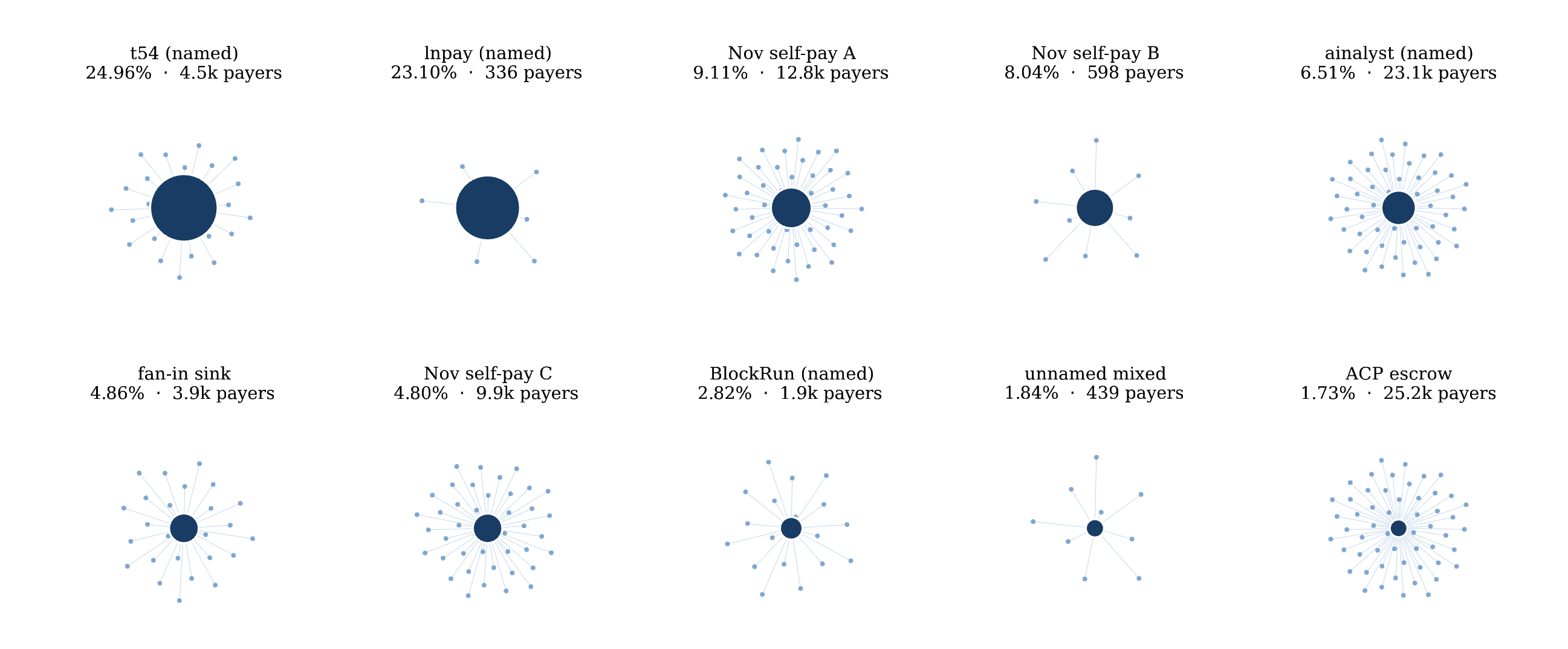
The image above is Figure 5 from the paper: each dark center is an operator (recipient), and the pale dots around it are the addresses paying it. It draws the star shape plainly: the money orbits a few operators rather than flowing through a real market.
Just these ten stars already account for a large share of the whole network. The top two operators, t54 and lnpay, together make up close to half; lnpay’s 23% of transactions come from just 336 paying addresses. Three of the ten are labeled “self-pay” outright: operators paying themselves.
Machine-timed means these addresses show no human rhythm: day and night, the activity is nearly a flat line. This one isn’t conclusive on its own (an agent can run 24/7 after all), so what really decides authenticity is still the more reliable test from before: whether the money left its own sphere. Gas-subsidized means that of all the on-chain fees behind these hundred-million-plus transactions, operators actually paid only about $350,000, because the gas was fronted for them by the facilitator. Subsidies meant to nurture real usage ended up mostly spent on this self-dealing traffic.
Settlement count measures “how much you can fake,” not “how many people are really using it.”
Why does it end up this way? Because the metric itself invites gaming. The cost of faking volume is near zero and the payoff is concrete: gas is fronted by the facilitator, leaderboards rank projects by transaction count, and some tokens’ narratives are pegged directly to volume. For an operator that just wants a bigger number, faking volume is the rational move, and that’s exactly what we observed on-chain. This is Goodhart’s law from economics: once a metric becomes a target, it stops being a good metric. A hundred million settlements is that law’s latest example.
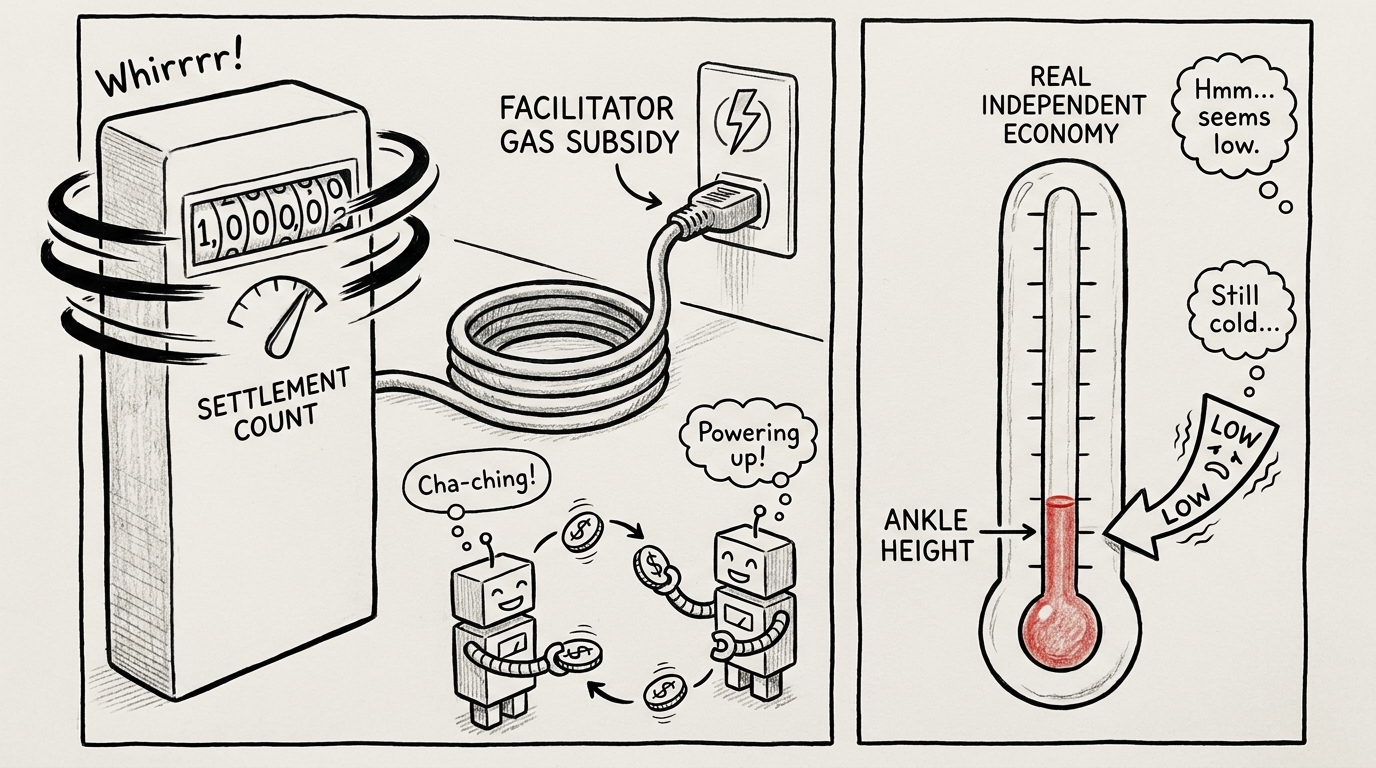
None of this means x402 is a scam, or that agent payment has no future. On-chain data can only prove the money didn’t leave this sphere; it can’t prove there’s zero real business behind it. The real problem lies elsewhere: we’re far too willing to take a number that costs almost nothing to manufacture and use it to certify an expensive conclusion: that real adoption has already happened.
Meanwhile, the money is pouring in
If you only looked at the data above, you’d assume this field is a ghost town. The reality is the opposite: capital keeps flooding in.
In October 2025, Tempo, a payments chain incubated by Stripe and Paradigm, closed a $500 million Series A at a $5 billion post-money valuation, led by Thrive Capital and Greenoaks (Fortune). A company whose mainnet hadn’t even formally launched was already valued at $5 billion.
The incumbents are moving in as a bloc too. On July 14, 2026, the x402 Foundation was established under the Linux Foundation, bringing in 40 organizations at once, 17 of them premier members. The names themselves aren’t the point; the composition is: card networks (Visa, Mastercard), cloud providers (AWS, Google), and stablecoin and payment firms (Circle, Stripe) all on the same list, camps that normally compete, now standing behind the same thing for the first time (PYMNTS). Going back further, over the past year card networks, foundation-model labs, and payment companies have each rolled out their own agent-payment offerings; we’ve covered those in an earlier series and won’t repeat them here.
Policy is pushing too. In July 2025 the U.S. passed the GENIUS Act, setting regulatory rules for dollar stablecoins for the first time; as of mid-2026, dollar stablecoins in circulation stood at around $264 billion (Visa Onchain Analytics), and the Treasury Secretary has publicly floated a vision of reaching three trillion by 2030 (Brookings). Stablecoin legitimization is widely seen as a precondition for agent payment to develop.
The bottom line: investors are in FOMO, enterprises are in FOMO. Fear of missing out is the most real emotion in this field right now.
Not every voice is bullish. In March 2026, the headline of a Bloomberg piece said it directly: “Stablecoin Firms Bet Big on AI Agent Payments That Barely Exist” (Bloomberg). Which is exactly the conclusion we reached from the data.
On one side: billions in valuation and the backing of 40 giants. On the other: more than 80% of settlements faked through self-dealing, and a real scale that might be only a few hundred thousand dollars. That gulf is the most divided thing about this field today.
Every bull-case argument holds up
By now you probably expect me to land on “it’s a bubble.” It isn’t that simple: every single argument for agent payment, taken on its own, holds.
Agents genuinely need to pay for themselves. An agent doing research for you might call a dozen paid data sources and buy a couple of small reports, all within seconds, with no human clicking “confirm” in between. Expecting a person to sit at the screen and sign off on every tiny expense defeats the point of using an agent at all. That’s precisely why a protocol like x402 exists: so an agent doesn’t have to wait for human approval on every payment and can settle these small amounts itself.
Card-network fees were never designed for this. Processing a transaction costs a card network roughly 2.9% plus $0.30. That rate is reasonable on a $100 retail purchase and completely uneconomical on a half-cent API call, where the fee is dozens of times the transaction itself. This isn’t about anyone being inefficient; it’s that this sixty-year-old system was simply never built for sub-cent payments.
And this use case is, by the data, actually growing. The crypto market maker Keyrock estimates that from May 2025 to April 2026, AI agents completed about 176 million transactions settling more than $73 million; roughly 76% of them were below the card networks’ $0.30 fee floor, most between 1 and 10 cents (CoinDesk). That 76% is exactly the part card networks structurally cannot serve and on-chain settlement can naturally absorb. This is the sturdiest point in the entire bull case: it doesn’t rely on any narrative; it’s a real need an old system can’t meet.
See the pattern: the need holds, the old system’s shortcoming holds, the real use case is expanding. String those three together and “agent payment is the future” follows almost inevitably.
And that’s exactly where the problem is: the smoother the derivation, the more careful you should be.
In hindsight success has a method; at the time, failure had its reasons too
How self-consistent an argument sounds has little to do with whether it ultimately comes true.
Looking back, every successful call seems well-reasoned, as if it should have been obvious all along. That’s textbook hindsight bias: we tend to forget that the calls that ended in failure sounded just as sensible at the time.
There’s one kind where the direction was right but the product was wrong. When the Segway launched, its inventor claimed it would be to cities what the car was to the horse; investors predicted it would be the fastest company ever to reach a billion in revenue; the press earnestly debated “whether cities should be redesigned around it.” The logic wasn’t absurd: cities are congested, the last mile is unsolved, standing and gliding beats walking. Yet that iconic self-balancing scooter never sold (about 140,000 units over twenty years) and was discontinued in 2020. The “personal electric mobility” it described did become a big business; it’s just that the product that made it big was the electric scooter, and Ninebot, the company that acquired Segway, makes exactly that (Segway history).
Another kind: the direction was right, only born too early. Webvan tried to disrupt supermarkets with grocery e-commerce (the logic being that groceries are essential, frequent, and a huge market) and burned through more than $800 million around 2000, going into liquidation less than two years after its IPO (Webvan); Pets.com tried to sell pet supplies online and lasted only about nine months from IPO to liquidation (Pets.com). Both directions look almost entirely correct twenty years on: grocery and pet e-commerce are big industries today. For the people who bet back then, “too early” and “wrong direction” were the same outcome.
And a third kind: even the direction itself hasn’t panned out. The 2017 ICO wave raised more than $20 billion in a little over a year on the story that “blockchain will re-architect the issuance of all value” (Decrypt); the 2021 NFT frenzy ran on “the revolution of digital ownership,” and by 2023 a study found that over 95% of NFT collections had gone to zero in market value (Forbes); the metaverse was billed as the internet’s next form, Meta even changed its name over it, and by early 2026 its Reality Labs had racked up more than $80 billion in cumulative operating losses since 2020 (CNBC). None of these stories was a scam at the time; each had a self-consistent, moving logic that smart people nodded along to.
Two scholars mapped out the reasoning behind this long ago. In Thinking, Fast and Slow, Kahneman writes that one of our deepest illusions is believing we understood the past, and therefore that the future should be knowable too; in fact, we understand far less about the past than we think we do (Thinking, Fast and Slow). Taleb calls this the “narrative fallacy”: people can’t just sit and look at a string of facts without insisting on wiring them into a causal chain; a black swan, too, is usually rationalized only after the fact, with the benefit of hindsight (Fooled by Randomness).
There’s another layer that gets mentioned less: survivorship bias. In World War II, the statistician Abraham Wald was tasked with studying where returning aircraft should be up-armored. The military’s data showed bullet holes clustered on the wings and tail; Wald argued the opposite: reinforce the engines and cockpit, which had no holes, because planes hit there simply didn’t make it back and so weren’t in the sample (survivorship bias). It’s the same with predicting the future: the successes we can see are the planes that flew home; the calls that were just as self-consistent but crashed, we never see. Losers don’t stand in the media spotlight, and no one remembers that their logic, at the time, was every bit as elegant.

I’m not saying this to be a wet blanket. The reverse holds too: bearish logic can be spectacularly wrong. In 1998, the economist Paul Krugman predicted the internet’s effect on the economy would be no greater than the fax machine’s (Quote Investigator); Ethernet inventor Robert Metcalfe predicted the internet would catastrophically collapse in 1996, then later, in front of an audience, literally put that prediction in a blender and drank it (Quote Investigator); in 2007, Steve Ballmer declared there was no chance the iPhone would get any significant market share (TechRadar); the most recent case is generative AI: in early 2023 ChatGPT hit a hundred million users in two months, the fastest-growing consumer app in history, and at that very moment even Turing Award winner and Meta chief AI scientist Yann LeCun publicly called it “not particularly innovative” and “nothing revolutionary” (user count via TIME; LeCun’s words via ZDNet). Every one of these calls sounded reasonable at the time.
So the conclusion is neither “the bulls are all fools” nor “only the bears are clear-eyed.” Whether an argument is self-consistent tells you almost nothing about whether a trend is real. Bull or bear, you can always tell yourself a seamless story. Storytelling alone can’t separate true from false for anyone.
So what should we actually judge by
If self-consistency can’t be trusted, what can we lean on? Over this stretch I’ve worked out a few tests of my own, not exhaustive but more reliable than “listening to the story.”
First, look at real demand, not the pretty numbers you can fake. That paper of ours comes down to this one point. A number that costs almost nothing to manufacture (settlement count, downloads, TVL) can’t serve as evidence of real adoption; you have to find evidence that has nothing to do with the act of “faking” itself: whether the money actually left the circle and reached a specific, real merchant. Back to x402: rather than fixating on the “hundred million” figure, watch that independent-economy range between $188,000 and $20 million, and whether it moves with real events or with some operator flipping a wash-trading script on and off.
Second, take the real demand seriously. That 76% below the card-fee floor is the least narrative-dependent fact in this field. It doesn’t guarantee x402 wins, nor that the winner will be on-chain, but it does guarantee that “letting agents make high-frequency micropayments that humans can’t” rests on a real economic foundation. One way to tell a genuine trend from pure FOMO is to ask: strip away every narrative, and is there still a real need the old system can’t serve? For agent payment, there genuinely is.
Third, don’t mistake “too early” for “wrong direction.” Roy Amara’s much-quoted line: we tend to overestimate a technology’s short-term impact and underestimate its long-term impact (Amara’s Law). Many so-called “failed” trends didn’t get the direction wrong; they were just a few years early: grocery e-commerce, video calling, and tablets all fit this. How to use it? Treat “is the direction right” and “is now the time” as two independent questions answered separately, and don’t let a burst of hype answer both for you at once.
Fourth, admit that bubbles have their uses. The economist Carlota Perez studied successive technological revolutions, and her observation is that bubbles are wasteful, yes, but the money that pours in during a bubble often ends up laying down the very infrastructure the technology really needs: railways and fiber were both built out this way (Perez). Even if most of the money 40 giants are putting into agent payment is wasted, it may still incidentally wire up stablecoin clearing, agent identity, and on-chain settlement: pipes the people who really need them will use in the next decade. So “there’s a bubble right now” and “this thing has a future” have never been in conflict.
These tests really come down to one thing: don’t just check whether it’s logically sound; look at whether there’s hard evidence unrelated to faked volume, whether there’s real demand, whether the time has come, and whether, even if the bet is wrong, it leaves something useful behind.
Faith in the trend, doubt in the numbers
Back to the opening question: of all this noise, how much is real?
My view is that the direction is probably right, but most of the numbers being used today to prove “it’s already here” are fake. These two things don’t contradict each other: it’s precisely because everyone believes the direction is right that people are busy faking numbers, trying to force it to ripen.
We do security work, and we deal with on-chain data every day. We’ve seen plenty of numbers get faked, and we’ve also seen some real demand slowly taking root. So: faith in the trend, doubt in the numbers. Agents will eventually have to pay for what they do. I still believe that. But a counter you can run up for almost nothing doesn’t earn a conclusion as big as “an era has arrived.”
The next decade of payments may really be coming. But whether it has actually arrived isn’t measured by how many more transactions show up on a leaderboard; it’s measured by whether anyone is really using it, really paying for real services.